Showing posts with label funk. Show all posts

Monday, June 11, 2012

Homebrew Recipe: Das Funken Weisse - Quick Sour Wheat Beer

Sorry to the four people who read this for the lack of posting over the last month. It's been a pretty crazy month. I went to Italy for a week in May and then there's work.... either way here's what I've been up to.

Back in mid April I brewed a sour wheat beer. Like most of my grists it was painfully simple, half Weyermann Pilsner and half American White Wheat. I did a small mash hop addition with some Willamette and a pretty low mash temp. Here's the fun part though, this thing was sour and ready to drink in a month (from the keg mind you). I started by pitching lactobacillus first and let it ride for 24 hours. Then I went in with a vial of WLP670 (American Farmhouse) and a smack pack of 3068. At one month it was dry, fruity, a touch funky and perfectly soured.

This could be bad info (I'm not a scientist) but from what I've read lactobacillus does poorly in the presence of alcohol, hence my pitching the lacto first. I kept it reasonably warm (76F) while it was all lacto, then about four hours before pitching the rest of my yeast I cooled it down to 68F. I suppose you could compare this beer somewhat to a Berliner Weisse in the sense that it's tart and sour and half wheat. But there's some other stuff happening too, a bit of spice and banana from the 3068, and some subtle brett character from the WLP670. Not to mention I threw two ounces of Citra hops into the keg. The result? A moderate strength, sour, funky, grapefruity and great beer.

Now granted I did make a great sour beer quickly, but I did keg it. I highly doubt the beer was completely done working, if you plan on bottling this you would probably want to give it a few months to ride out the last few gravity points.

Das Funken Weisse

OG - 1.046
Brewhouse Efficiency - 75%
IBUs - 6.8
Mash Type - Single Infusion
Mash Temp - 148F

Malts and Fermentables

4lbs. Weyermann Bohemian Pilsner Malt
4lbs. American White Wheat

Hops

Willamette 5.5%AAU Mash hop - .5oz. - 60 minutes 
Citra 10.5%AAU - Keg Hop - 2.0oz


Yeast and critters

Whitelabs WLP670 American Farmhouse
Whitelabs Lactobacillus Delbrueckii
Wyeast 3068 Weihenstephan

I'll post a full tasting of this soon. But if you're looking to homebrew a sour beer quickly you may try this and see how it works out for you.

Wednesday, April 25, 2012

Un Poquito Wylde Tasting

Now that my kegerator is fully operational again, and this keg is fully carbed, I can finally get around to tasting the micro saison I made with my local wild yeast. If you remember the grist was simple, half Vienna malt and half white wheat malt for an OG of 1.032.

For such a simple and small beer this thing has a lot going on. I think it's really cool to make a beer that is completely unique to your area. Unfortunately that's a hard thing to do here in South Texas where mold runs rampant most of the year. I probably tried harvesting yeast 5 or 6 times before I got this last round to actually work without any sort of infectious mold. All in all the flavors of the yeast are relatively mild. Brett character mostly. If I decide to reuse the yeast (which I did wash and save in a growler) I expect some more lacto/pedio character to develop.

Appearance is a ruddy straw color. From the tap a one finger pristine white head forms. The head sticks around quite a bit, that's thanks to the wheat.The head is a little bit alive, with rocky chunks of foam forming and dissipating. Beer is quite cloudy, yeast was not very flocculant. Even with a week of cold crashing, I may decide to hit it with some finings..

The aroma is interesting to say the least. A bit of crackery malt, and a touch of Czech Saaz pokes through, then just awash from the yeast. Solid Brett character, pineapple and other non-descript tropical fruits first, followed by danky bretty must and funk.

The taste follows suit right along with the nose. A bit of Czech saaz character makes itself known up front then gets washed away with Brett character. Tropical notes of pineapple and mango dominate the palate followed by a slight bit of musty Brett funk. A light bit of lactic sourness hits the back of the palate. Finishes dry, but that's too be expected.

The mouthfeel is surprisingly full for such a small beer. The large amount of wheat really helped with that, but there's also a certain silkiness to it that I believe to be coming from the yeast... a lot like what you would get from a saison yeast. I carbed it only to 2.5 volumes to keep it from being astringent, but it's not quite lively enough. So I think I'll up the pressure for a couple of days to see how that helps.

Overall it's a great beer, that's nice and refreshing as it's getting hot out. I think I'm going to try to let it live in the kegerator for a month before I completely finish it. I'd like a bit more acidity to develop. This yeast is interesting and could play well for a larger beer.

Edit 4/26: Decided to throw an ounce of Czech Saaz into the keg. I'm loving the character of the beer so far, but would really like some more hop character.

Sunday, March 18, 2012

Wild Yeast Micro-Saison


To continue with both my session beer kick and my funky brewing project this week I decided to brew with some local wild yeast that I harvested back in January. I wanted to brew something that would display the yeast quality well without too many other competing flavors. That's why I went with a very low ABV saison. I'm posting about this because for one I think it's really cool to gather your own yeast, but also because there's not really a lot of info available. The pic above is from when I propped it up. You can see the yeast cake on the bottom. The plastic ontop. Is because all of my airlocks were already in use.

I've tried harvesting wild yeast before but all I would get was mold and/or something that just smelled rank. Here in Texas the mold is pretty high so its not the best environment for catching wild yeast. What made this attempt different was that for one it was on one of the few cold nights we see in San Antonio, I've read that during colder weather the bugs are more at bay. I also made sure to wait for a night when the weather report listed the mold count as low/none.

I whipped up a weak dme sollution of 1.030(ish) and split it into two seperate mason jars. I covered them with a bit of cheesecloth to keep flies out and left them out overnight. One went out on my front porch and another on my back porch. Once brought in I covered them with plastic. I ignored it for a while, then before I knew it it had been a week. Checked it and... nada. Nothing had happened. After another 5 days one finally fermented with some nice little yeast rafts floating on top. Two days later the second followed suit. I decided to prop them up together with some late runnings from my lambic. I shook well, gave it nutrient etc... and nada. I decided to leave it alone and ended up forgetting about it. Two weeks had passed and I went to throw it out and sure enough there were yeast rafts on top and a cake on the bottom. I crash chilled it and left it. Then two nights ago I decanted it and threw in another round of starter wort, this time it took off in 12 hours.

When I decanted I took a sample. The smell was wonderful, very fruity with notes of lemongrass and peach plus a light spice. There was also a light sourness to the aroma and a bit of funk. The mouthfeel was quite silky and full. So perfect for a saison.

The brewday was very easy with a very small and simple grainbill. I went with a no sparge method to help accentuate the malt profile. The grainbill was simple, half Vienna half malted wheat. I chose both of those malts to help with the body/malt impression of the beer. The high percentage of wheat should make the mouthfeel reasonably full and the vienna malt should add a bit of breadiness to it. For hops I went with classic Czech Saaz, their spiciness should play well with the characters that I was picking up from the yeast. I only did a single 15 minute addition of the hops, depending on where this beer goes I may end up adding a dry hop addition.


Mash profile: Medium dry 151
OG: 1.032
IBUs: 7.4

Mash ingredients
3lbs. Vienna malt
3lbs. White wheat

1oz. Czech Saaz 4.1% AA 15 minutes.

Yeast: Wild caught yeast from 78247 area code.

Quick update: Despite the long lag time from when I propped this up it took off like a rocket today with onlya six hour lag time.

The Great Souring Project 2012


I have a goal to brew 8 sour beers this year. Ambitious huh? I even made a list of all the things I plan to sour. My plan is to brew two sours every 3 months and then next year I'll have a metric crapton of sour beer to play with/blend. I brewed the first one about two months ago.

The recipe was loosely based on my Belgian Single. I really liked how tight and controlled all the flavors were in that beer. Everything about marked subtlety. I didn't want to brew a sour with a hugely complicated grain bill and end up with too many competing flavors. My goal was just to brew something good, relatively low alcohol and of course sour.

I subbed out the pilsner for two row and upped the wheat a little bit. I kept the chocolate malt and the 60L the same, but also threw in a bit of Victory and Munich for some more malt backbone. After the wort was chilled to about 72 degrees I pitched a pack of the Wyeast Roeselare. No starter and I didn't smack the pack. The roeselare is a very specific blend. Wyeast does not recommend propping it up at all as it will throw off the blend, for that reason I also didn't bother smacking it.

Active fermentation inside of 12 hours that continued for about two weeks. At the one month mark I opened up the carboy to get a smell and a couple hours later fermentation had kicked back up. I'm assuming that it was just the bugs responding to oxygen being introduced.

After two months still no pellicle formation.

O.G. 1.054
IBUS 7.4
Mash Schedule: Single infusion. 152.

Mash Ingredients

7lbs. 2-Row - US
2 lbs. 3oz. White Wheat
1 lb. Munich - 10L
1/2 lb. American Crystal - 60L
1/2 lb. American Victory - 10L
1/4 lb. American Chocolate 325L

.5oz. Willamette Hops 5.4%AA Pellet - 45 minutes

Critters - Wyeast Roeselare Blend

Here's list of sour beers I plan/hope to brew sometime this year

1. Berliner Weiss
2. Low abv. sour/hoppy saison.
3. Saison with my wild caught yeast.
4. Sour peach and plum saison (actually something I've made before)
5. Soured dark mild.
6. Soured robust porter.
7. Soured Belgian golden ale.
8. The one I have fermenting now.

Sunday, February 13, 2011

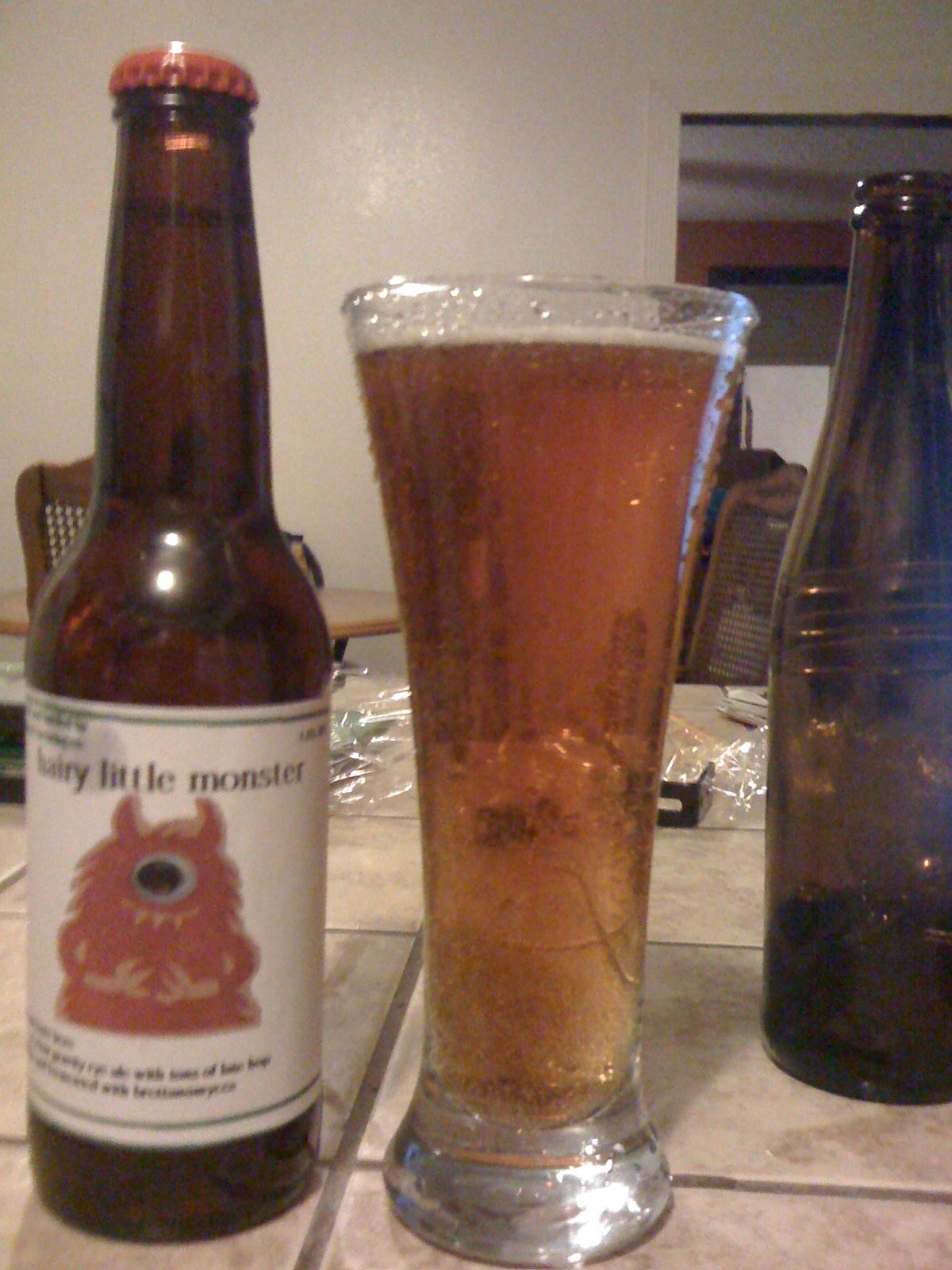
First Tasting: Hairy Little Monster


Not too long ago I brewed this funky rye hop bomb. And I'm drinking the first bottle now.


Appearance - Golden reddish in color. Pours a creamy frothy white head. You can't tell it from the picture because I accidentally over - poured and the foam went over the side.

Aroma - Nice noble hop notes, but I could use more. I probably should have dry hopped... oh well. Smokey and in a big way. There's no smoke malt in this beer, that's a total function of the brett l. Hints of sour cherry and some pepperiness (from the rye).

Taste - Big rye spiciness. There is some definite bitterness to it, but not from the hops so much as it is carbonation astringency. That malt is toasty as well... almost bready. I'm also getting the smokiness that was in the nose, and in a big way.

Mouthfeel - Very VERY full for such a dry beer. I'm not sure exactly what that's a function of... but I like it.

Overall - I think this ended up being a successful beer and pretty close to what I was hoping to achieve; which is a low gravity ale with tons of flavor. However I think that the brett character could stand to be more restrained, maybe use it as a later fermenter and not during primary along side a sacch. strain like I did. I also think I nice dosage of dry hopping would really be neat.

Wednesday, February 9, 2011

Hair Little Monster - Funky Rye Hop Bomb


What I wanted to make was something light and sessionable with tons of flavor. My grist was a lot of two row and malted rye, a touch of wheat and some 60L crystal malt. I hopped it with only late hop additions to keep the bitterness low but the hop flavor big. For the hops I used mostly Willamette and some Target.

The fermentation was done by pitching both Dry Nottingham yeast and Brettanomyces Lambicus (for tha funk).

Recipe:

O.G. 1.050
F.G. 1.008
5.6% ABV
Color: 8 SRM
19.1 IBUs
73% Efficiency

Malt
6.5 lbs. American 2-Row
4.25 lbs. Malted Rye
.75lbs. American Crystal 60L
.5 lbs. White Wheat Malt

Hops
1 oz. Target Hops 8.6%AA 20 Minutes
1 oz. Willamette Hops 5.5%AA 10 Minutes
1 oz. Willamette Hops 5.5%AA 5 Minutes
1 oz. Willamette Hops 5.5%AA 1 Minutes

Yeast
Dry Nottingham
Brettanomyces Lambicus

Mash at 149 for 90 minutes. 75 minute boil. Collected 5.5 gallons of wort. Ferment relatively cool at 66 degrees for 15 days. The brett can take some time to clean up and finish drying it out. Cold crash for 4 days before bottling. Carbonated to 2.5 volumes. Tasting notes to come.

Brewed on January 14 2011.
Bottled on February 2 2011

Joie de Vivre - Soured Saison

This is another beer I brewed not too long ago for a friends wedding. I have the advantage of living in a house with a peach tree in the front yard. And when life gives you peaches... you ferment them. Earlier in the year I made a peach saison that was very nice and refreshing but somewhat lacking. For this batch I decided to sour it a little bit. I wanted to control the souring as much as possible so I went with a partially soured mash, in lieu of adding bugs.

This beer ended up being quite exceptional. The first bottles I opened were very funky on the nose... smelled a lot like vomit. However three months later, by the time the wedding rolled around, the smell had been down-graded (to as the guests called it) "feet". I saved a few bottles for myself and as they aged (6 months was perfect) the fruit in the beer came out quite well and the lactic smell degraded immensely. The acidity of the souring accentuates the fruit in a big way. The taste is very fruity without being sweet, in fact this is a very dry beer.

The grist is primarily Belgian pilsner malt to provide a sense of sweetness with a little bit of Vienna malt to add some body and then torrified wheat to fill out the body. The 40L crystal is to add a little color.

For the fruit I used some of my homegrown peaches that I blended into a puree and then froze. I threw those into the wort at flameout (great way to help chill the wort). And then after primary fermentation I added some under-ripe plums. I went with under ripe to add some tartness.

I went with two different yeasts. The WLP 530 is for the nice fruitiness and spiciness, and then saison is for the great silky mouthfeel. Plus the 3711 is a fast fermenter.

I wanted to keep the sour to a minimum. As dry as this beer is, too much souring could be overwhelming.

Here's the recipe.

9lbs. Belgian Pils
2 lbs. Vienna Malt
1 lb. Torrified Wheat
8oz. C-40L

2 oz. Willamette 5.5%AA - 45min.

6.8 lbs. Homemade Peach Puree
5 lbs. Underipe Plums

Sour - 1 lb. belgian pils 1 lb. Light LME.

The day before brew day prepare the sour by adding the LME to 2 quarts of water and heat to 130 degrees. Pour the water in a bucket and add the 1lb. of pils. Do everything you can to keep this as warm as possible. In the central Texas summer heat I just left it outside, but you can wrap it in a heating pad too. Within 24 hours it should smell like satan's anus.

Mash the grains at 152 with 4.25 gallons of water, along with the sour. This may seem like a high mash temperature for a saison, but the fruit in this beer is 100% fermentable and will be enough to dry it out. Do a 10 minute 168 degree mash out, then batch sparge with 4.5 gallons of water.

Boil for 90 minutes to drive off the DMS. At the end of the boil add the frozen peach puree.

I pitched a 750ml starter of WLP530 Abbey Ale and a vial of Wyeast 3711 French Saison (love this yeast). Ferment for 2 days at 68 then ramp up to 75 over the course of four days. Once the krausen has dropped add the plums to the fermenter and let set for two weeks. Final gravity for me was 1.005. Rack and condition to 3 volumes.